 Confocal microscopy has become an essential tool for life sciences researchers. The confocal’s ability to optically slice through thicker specimens, excluding the out-of-focus light while imaging just the focal plane, makes it the technique of choice for high-resolution fluorescence microscopy. But with several different kinds of confocal microscope available, which one should you choose for your experiment?
Let’s look at three different kinds of confocal microscope, with a particular emphasis on how well they perform optical sectioning and the quality of the resulting images. The laser-scanning confocal is the “original” confocal, and can still be considered the gold standard, particularly for fixed samples. For live-cell imaging, a well-equipped spinning-disk confocal can give you fast frame rates and can be less phototoxic to the cells. Finally, if budget is a concern for you, we consider whether the grid-based optical sectioning microscope (sometimes called “structured illumination”, not to be confused, though with the superresolution techniqute of the same name) will be adequate.
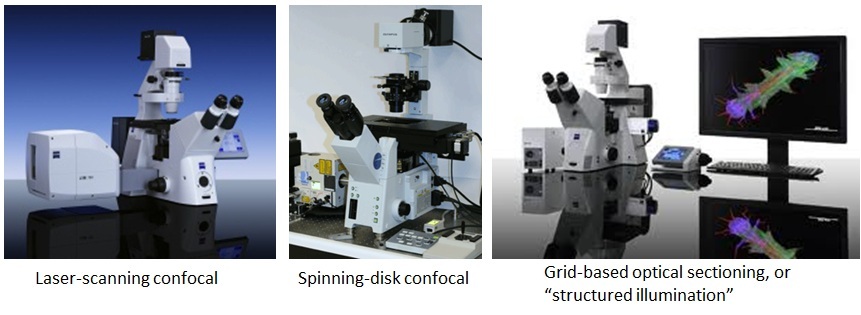
Optical sectioning performance (and microscope performance in general!) actually depends on the thickness of the specimen and the density of the labeling, so we will compare the confocals using 3 samples of different thicknesses:
- Thin (5um): Cultured BPAE cells (Molecular Probes Prepared Slide #1)
- Intermediate (15um): Mouse kidney section (Molecular Probes Prepared Slide #3)
- Thick (35-50um): 3D Culture of mammary epithelial cells (courtesy of Hui Wang, OCI)

Laser-scanning confocal
The classic laser-scanning confocal scans a focused laser beam back and forth across a sample, in a raster pattern. At each position, the focal point is imaged through a pinhole onto the detector – the pinhole blocks out-of-focus light from being detected.
Spinning-disk confocal
A laser-scanning confocal is relatively slow, scanning a single focused spot across the sample and measuring the fluorescence intensity one pixel at a time. The spinning disk sweeps about 1000 beams of light around the sample in parallel, and images them through a disk with a thousand pinholes onto a sensitive camera. This is the spinning-disk confocal’s main advantage over it’s laser-scanning cousin: speed! However, to achieve decent speeds they are typically configured with a 512 x 512 pixel EMCCD camera, which sacrifices resolution to give you large, super sensitive pixels.
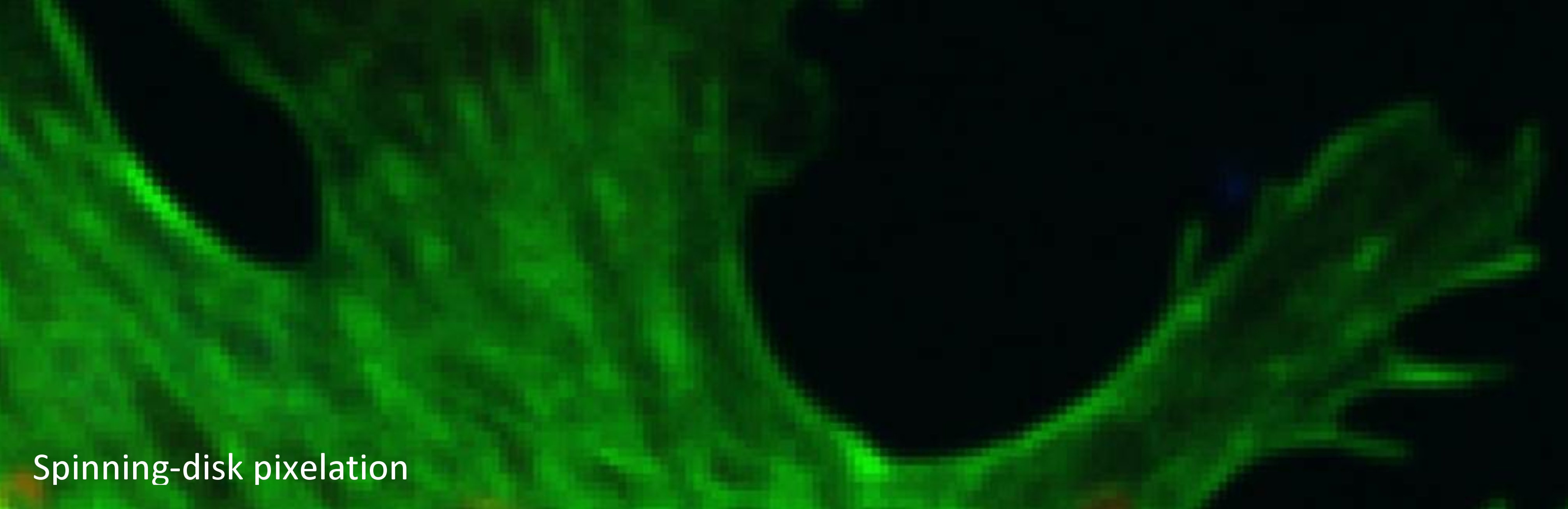
… especially when you zoom in.
Apotome
For the thicker sample, the Apotome image is very noisy (despite setting the algorithm to its maximum smoothing), and more-or-less unuseable except maybe near the surface. The reason for this is that, as the sample gets thicker, the grid pattern that is projected into the image gets obscured by the out-of-focus blur. I would say that grid-based optical sectioning is limited to samples that are at most 20um thick.
Acknowledgements
My thanks to Dan Stevens of Carl Zeiss Canada for help with acquiring the Apotome images; Hui Wang of OCI for providing the 3D culture of mammary epithelial cells; and of course my team Miria, Judy, and Feng at the AOMF.

 clairembrown
 James Jonkman
 Microscopy Solutions